Open-source parametric CAD
TeleSAPR is a parametric 2D/3D CAD program. Draw sketches held by dimensions and constraints, build solids from them feature by feature, assemble parts and put them on drawings. Every step can also be scripted in Go, or asked of an AI model.
Features
A constraint solver at the core, a history of features on top, and a solid modelling kernel with exact curved surfaces.
Lines, arcs, circles and curves held by dimensions and geometric constraints. Entities are coloured by how free they are, and conflicts are marked.
Extrude, revolve, sweep, loft, shell, draft, mirror and patterns, with Boolean union, difference and intersection.
Rounded and chamfered edges and corners, edges of their own radius, and rolling-ball fillets between curved faces.
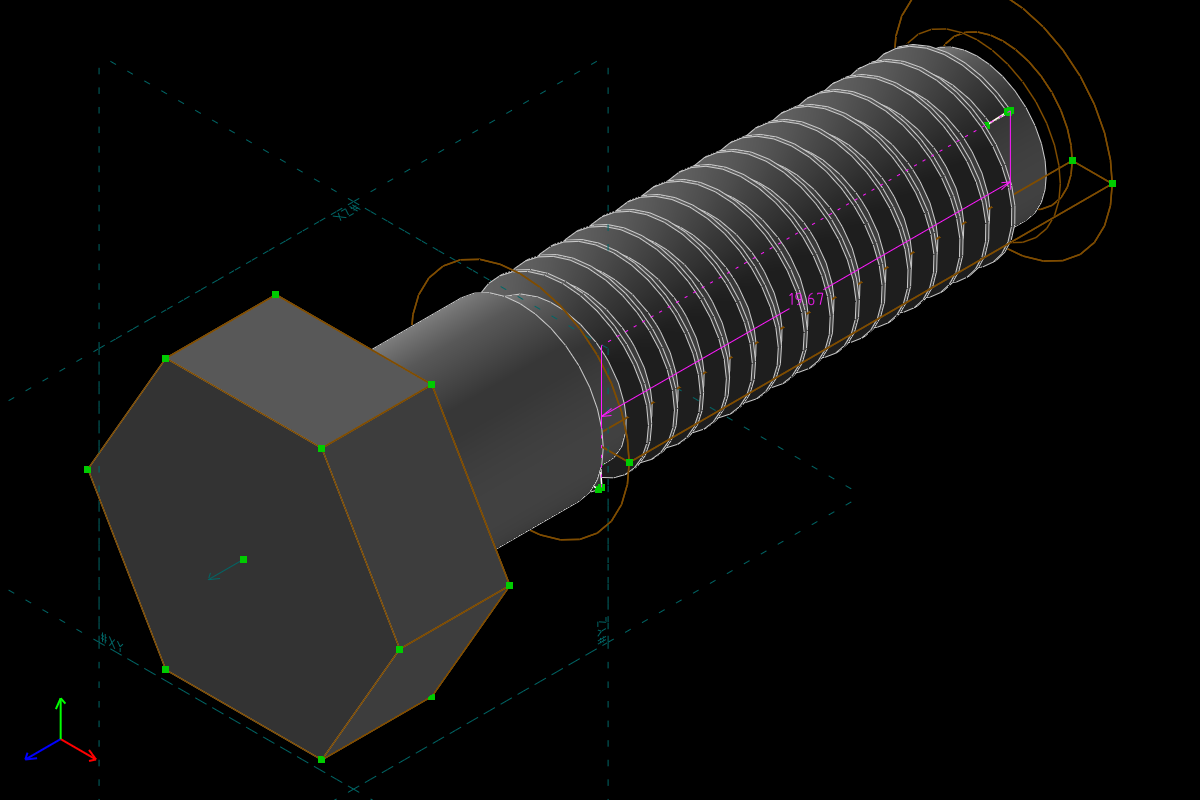
Metric, unified, pipe, trapezoidal and ACME threads, modelled or cosmetic, with run-outs, and drawn by the drafting convention.
Named values and expressions drive dimensions and feature values. Change one number and the whole model follows.
Any edge of a solid is saved by a stable name, so fillets and chamfers stay where they were put when the model upstream changes.
Linked parts with configurations, datums mated by name, screw mates, mass properties, a bill of materials, and clearance and wall-thickness checks.
Sheets with projected views, sections and details, dimensioned and exported to PDF, SVG or DXF.
Every command has a script call. Run scripts in a console, from a file or headless from the command line, and write a model back as the script that builds it.
Any MCP client, such as Claude, can draw in the window you have open from a request in plain English. Each step is one undo.
Section view, Check Solid for watertight and sound geometry, volume, centre of mass, and measuring without adding a constraint.
STEP import as reference or solid, STEP export with exact surfaces, and mesh export with quality presets.
About
TeleSAPR began as a port of SolveSpace, the
parametric CAD program by Jonathan Westhues and the SolveSpace authors, from C++ to Go. It
has since become a separate project with its own modelling kernel, features and file
format, .tlspr; SolveSpace's .slvs files still import.
Free and open source. Installers and archives for every release are on SourceForge; the source code, guide and issue tracker are on GitHub.
 TeleSAPR